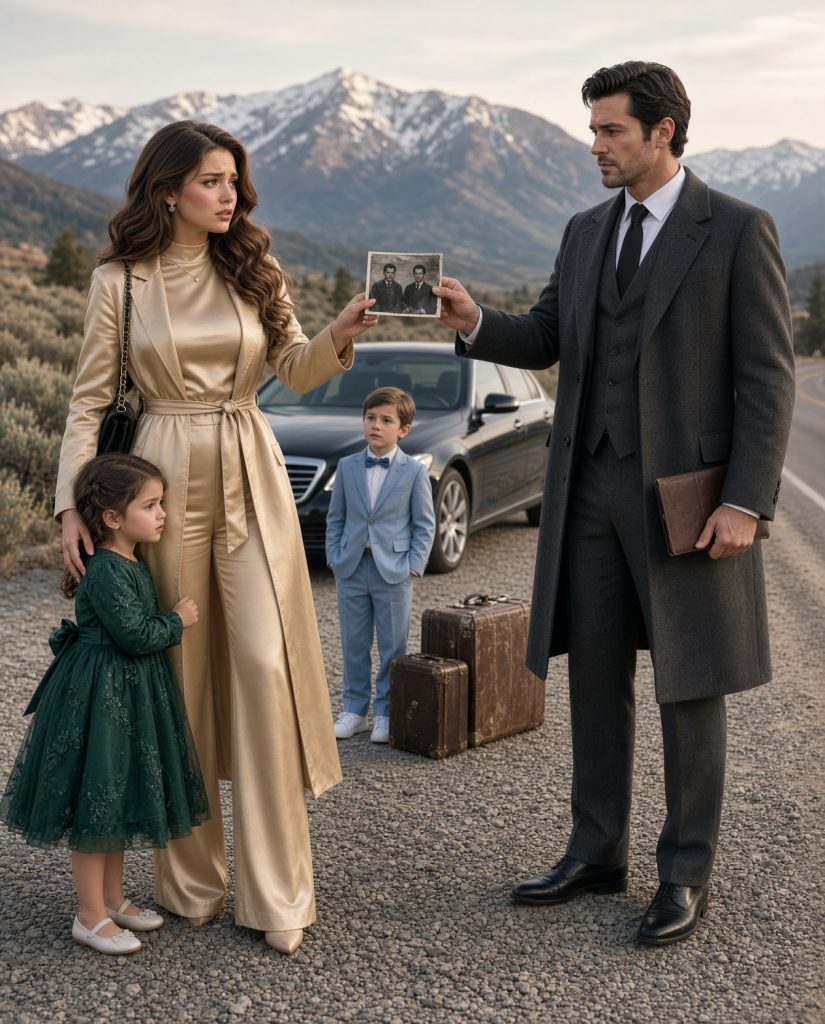
By the time Mrs. Kessler dropped our suitcases onto the gravel, I had stopped expecting kindness from strangers.
She had rented Owen, Maisie, and me a room for three nights in a faded boarding house outside Jackson, Wyoming. I had told her I was waiting for the regional bus that would take us north to a seasonal kitchen job at a mountain lodge. On the third morning, when I admitted the bus still had not come, she decided our problem had become contagious.
"I rented you a room, not a rescue service," she said, setting my second suitcase beside the highway marker.
Then she drove away.
I was thirty-four years old, with seven dollars, two hungry children, and a phone battery blinking at nine percent. Six-year-old Owen tried to act brave because he thought that was what boys were supposed to do for their mothers. Four-year-old Maisie did not have the energy to pretend. She sat on a suitcase and pressed both hands over her stomach.
"Is the bus late again?" Owen asked.
"Maybe," I said.
It was a cowardly answer, but it bought me a few more minutes before I had to admit I did not know what came next.
The job waiting near Jackson was not glamorous. It was prep work, dishwashing, and breakfast service at a lodge kitchen. But it came with employee housing, and after the catering company where I had worked closed, housing mattered more than pride. I had sold nearly everything we could not carry. I had told the children the trip was an adventure.
Now our adventure was an empty highway and a silence so wide I could hear wind dragging grit across the shoulder.
The black sedan appeared a little after noon.
It slowed long before it reached us, then stopped twenty yards ahead. I stood and moved in front of the children. The man who stepped out wore a charcoal overcoat over a dark suit, the kind cut so precisely it made me suddenly aware of every stain on my own sleeves. He kept his hands visible and stopped several paces away.
"I'm Julian Vale," he said. "That bus is not coming."
I almost snapped at him. For two days, every person I called had given me a different answer. A clerk at the boarding house said the route ran Tuesdays. Someone at a gas station said it had changed companies. An automated number told me to check a website that no longer loaded.
Julian took out his phone, called the regional terminal, and put the dispatcher on speaker. The woman confirmed that the carrier had filed for insolvency. The route had been suspended three days earlier.
At least one awful question had an answer.
I stared at the road, then at my children, then at the man whose shoes probably cost more than our luggage.
"Do you know anyone hiring?" I asked.
He looked surprised.
"I'm not asking for money," I added quickly. "I'll clean. Cook. Wash sheets. Anything. I just need work before my kids miss another meal."
He asked my name.
"Claire Holloway."
His expression changed so quickly I nearly missed it.
"Your father was Thomas Holloway?"
The question sent cold through me.
"He died seventeen years ago."
Julian nodded once, like a man hearing confirmation of something he already knew.
"I can offer you work," he said. "But the position is going to sound insane."
I had been stranded with two children on a dead bus route. My standards for insane had become flexible.
"What position?"
"My wife."
I stared at him.
Julian did not smile.
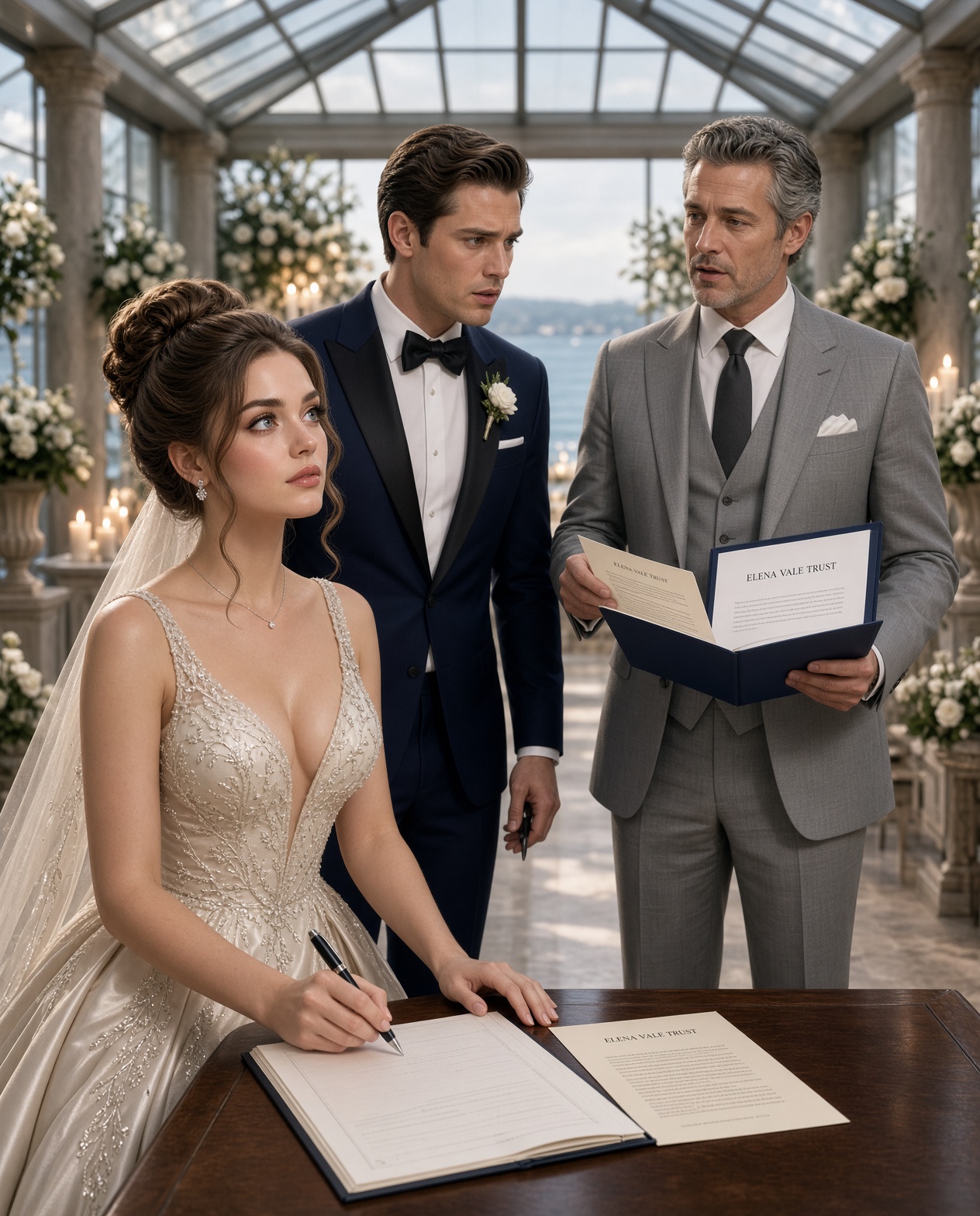
He explained it with the unsettling calm of someone who had rehearsed the words and hated every version. One year. Civil marriage. Separate rooms if I wanted them. Independent attorneys. A written salary. Private schooling or public-school support for the children, my choice. Housing in my own name for the full contract term. No clause requiring romance, intimacy, or shared finances. A clean exit at the end.
I laughed once because if I did not laugh, I might have screamed.
"I asked for a kitchen job."
"I know."
"You don't know me."
"I know your name. That's why this is complicated."
He told me his family controlled Vale Meridian Group, an old company that owned hotels, mountain rail lines, and large stretches of resort land. His grandmother had left a block of voting shares in a trust with an old-fashioned condition: if Julian reached forty-three unmarried, temporary control of those shares would pass to his uncle, Malcolm Vale, for ten years. Julian's birthday was twelve days away.
I told him that sounded like the sort of rich-people problem that should stay far away from my children.
"It should," he said. "Except your father is connected to it."
From a leather folio, he removed a worn photograph. In it, two younger men stood beside a mountain airfield. One was Julian's late father. The other was Thomas Holloway.
My father.
He had the same crooked smile I saw in the mirror and the same chipped brass compass I remembered turning over in my hands as a child.
The photograph was old. It proved our fathers had known each other. Nothing more.
Julian agreed before I could accuse him of trying to manipulate me.
Then he called Evelyn Price, the Vale family's longtime outside counsel. A silver-haired attorney appeared on video, seated in an office lined with legal binders. She asked me to confirm my father's full middle name, then lifted a notarized document to the camera.
The signature at the bottom looked exactly like his.
Evelyn met my eyes through the screen.
"Claire, your father Thomas James Holloway signed this trust amendment in Boston eleven weeks ago."
My knees nearly gave out, but Owen's fingers tightened around mine and kept me standing. Thomas had not been hiding from Julian or from the police; he had been living under federal protection because Malcolm Vale, Julian's uncle and the chairman of Vale Meridian, had tried to silence him seventeen years earlier.
Evelyn turned the notarized page toward the camera. Thomas had survived the helicopter crash everyone believed killed him. Before the wreck, he had copied ledgers showing Malcolm diverting employee pension money through shell companies. Julian's late father helped Thomas reach federal investigators, but the case went under seal after two witnesses vanished. Thomas stayed hidden because he believed appearing publicly would put me in Malcolm's reach.
Then Julian explained the marriage offer. His grandmother's voting trust would pass to Malcolm if Julian reached forty-three unmarried in twelve days. Thomas's new amendment transferred an eleven-percent founder block to me, but only after identity verification. Together, those shares could force an independent audit and stop Malcolm from taking control before the evidence surfaced.
"I am not asking you to trust me on a highway," Julian said. "I am asking you to let an independent lawyer explain every risk. Your children eat first. You can refuse me after that."
That mattered more than the car, the money, or the impossible promise. He was giving me a choice when desperation had stripped almost every other choice away.
I looked at Owen and Maisie. Then I looked at the photograph of the father I had mourned for seventeen years.
"Food first," I said. "Lawyer second. Then I decide whether your family gets to call me anything at all."
Julian did exactly what he had promised in the order I had demanded.
Food first.
He drove us to a Vale Meridian lodge thirty minutes away, but instead of taking us through the grand lobby, he asked a manager to open a quiet staff dining room. Owen ate tomato soup and two grilled-cheese sandwiches. Maisie fell asleep halfway through a bowl of macaroni. I watched them eat before I touched my own plate.
Julian sat at the far end of the table and made no attempt to sell me the marriage again.
An hour later, a woman named Dana Brooks arrived. She was not employed by Vale Meridian. Evelyn had found her through the state bar's referral service after I insisted that no lawyer chosen by Julian could represent me. Dana spent twenty minutes alone with me before she even looked at his proposed agreement.
"The trust condition is unusual," she said, "but the document appears real. That does not mean you should marry him. It means we verify everything before you decide."
Those were the first words anyone had said all day that made me feel sane.
For the next forty-eight hours, verification replaced drama.
Dana contacted the attorney who had notarized Thomas's amendment. A private laboratory confirmed that the DNA profile attached to an old federal record was consistent with a sample Thomas had recently provided through counsel. Evelyn produced copies of the original Vale Meridian founder agreements showing that Thomas had received a small equity block when he helped restructure the company in the 1990s. The shares had been placed in a dormant trust after his presumed death. His new amendment named me as successor beneficiary.
Eleven percent.
Enough to matter.
Not enough to make me safe.
Malcolm Vale learned I existed before the second day ended.
A black SUV appeared outside the lodge. Then another. By evening, a business reporter had left three messages asking whether I was a previously unknown Vale heir. I was not. The question was deliberately wrong, but it told me someone had begun shaping a story in which I was a gold digger before I had signed anything.
Julian looked furious when I played the voicemail.
"Malcolm," he said.
"You don't know that."
"No," he said. "But I know his methods."
That answer mattered too. He did not ask me to accept his suspicions as proof.
Dana and I rewrote the proposed marriage contract until Julian's original draft barely existed. The children's housing fund would become irrevocable the day the marriage was registered, whether I stayed married one week or one year. Julian would have no voting authority over my inherited shares. I would have no authority over his personal assets. My salary would be deposited into an account he could not access. Any testimony I gave about Thomas, Malcolm, or Vale Meridian would remain entirely my choice. The contract prohibited either of us from using the children in company publicity.
When Julian read the final version, he signed without bargaining.
"You expected me to make this harder," he said.
"I expect everything to be harder. It saves time."
For the first time, he smiled.
The harder conversation came that night.
Evelyn arranged a secure video call with Thomas.
For seventeen years I had imagined what I would say if the dead could answer. I had imagined screaming. I had imagined hugging him. I had imagined telling him every birthday he missed, every school performance, every time I needed a father and had only a photograph.