By the time Theo stopped asking for pancakes on Saturday mornings, I knew something was wrong.
In our house, breakfast had always been his loudest hour. He drummed spoons against the marble island, argued about whether blueberries counted as a vegetable, and tried to convince our housekeeper that a ten-year-old needed espresso. The limestone mansion Adrian's family had owned for three generations could feel absurdly formal, but Theo made it human. He left chess pieces under sofas and science books open on the grand piano. He turned the long gallery outside the library into a sock-skating rink whenever no guests were around.
Then, over three weeks, the noise thinned out.
He complained of stomach pain after meals. He began leaving half his lunch untouched. One evening I found him sitting on the heated bathroom floor, pale and sweating, insisting he was fine because his father had an important foundation dinner downstairs.
Adrian barely looked up when I told him.
"He has a school presentation on Monday," he said. "Theo gets anxious before anything public."
"This isn't nerves."
"You always think the worst."
That answer landed harder than it should have because Adrian had once been the parent who noticed everything. When Theo was a baby, he could tell the difference between hungry crying and tired crying before I could. He had learned how to sterilize bottles, packed emergency snacks in every car, and slept on the nursery floor during Theo's first fever.
But in the past year, as Adrian took control of the Armitage Children's Foundation, something in him had tightened. Every conversation became a calculation. He guarded his study. He changed passwords. He began taking phone calls outside even in winter. And when Theo's pain started, Adrian's impatience sharpened into something I could not explain.
"No hospital," he said one night after Theo pushed away soup. "Not unless he has a fever or he's vomiting."
"He can barely finish a meal."
"And if we walk into St. Gabriel's with our name, by lunch someone will be whispering that the Armitage heir is seriously ill. We have the donor vote next week."
I stared at him across the dining table.
Our son was hunched in the next room, and Adrian was talking about headlines.
I started keeping notes on my phone. Pain after breakfast. Pain after school. No bowel movement for two days. Then one. Then another day of cramping. I photographed the meals Theo could not finish, not because I wanted evidence against my husband, but because Adrian had made me doubt my own eyes.
The final push came on a Thursday morning. Theo stood in front of his closet wearing one sock and holding the other in his hand. He bent to pull it on, froze, and folded forward with a sound so small it frightened me more than screaming would have.
I helped him onto the bed.
"We're going to a doctor."
His eyes shot toward the doorway.
"Does Dad know?"
I should have heard the fear in that question. Instead I thought he was worried about another argument.
"He doesn't need to know until I know what's happening."
Theo nodded too quickly.
Adrian had already left for a breakfast with the foundation's outside auditors. I told the staff that Theo and I were going to school late, then drove forty minutes to a private pediatric imaging center where I had once taken a friend's daughter. I chose it because the clinic had no connection to the Armitage foundation, no family wing named after Adrian's grandfather, and no administrator who would call my husband as a courtesy.
Dr. Sameer Shah examined Theo himself. He asked when the pain had begun, where it hurt, whether there had been nausea, whether Theo had swallowed anything he should not have.
Theo stared at the wall.
"No," Adrian's son said.
Something about the way he said it made Dr. Shah repeat the question later, after bloodwork showed inflammation.
The ultrasound room was dim except for the monitor. Theo lay on his back while the technician moved the probe over his lower abdomen. I stood beside the table holding his hand and watched gray shapes move across the screen without meaning anything to me.
Then the technician stopped talking.
She adjusted the angle. Took a measurement. Called Dr. Shah.
He studied the monitor, asked for a second view, and then ordered a quick X-ray to confirm what the ultrasound shadow suggested.
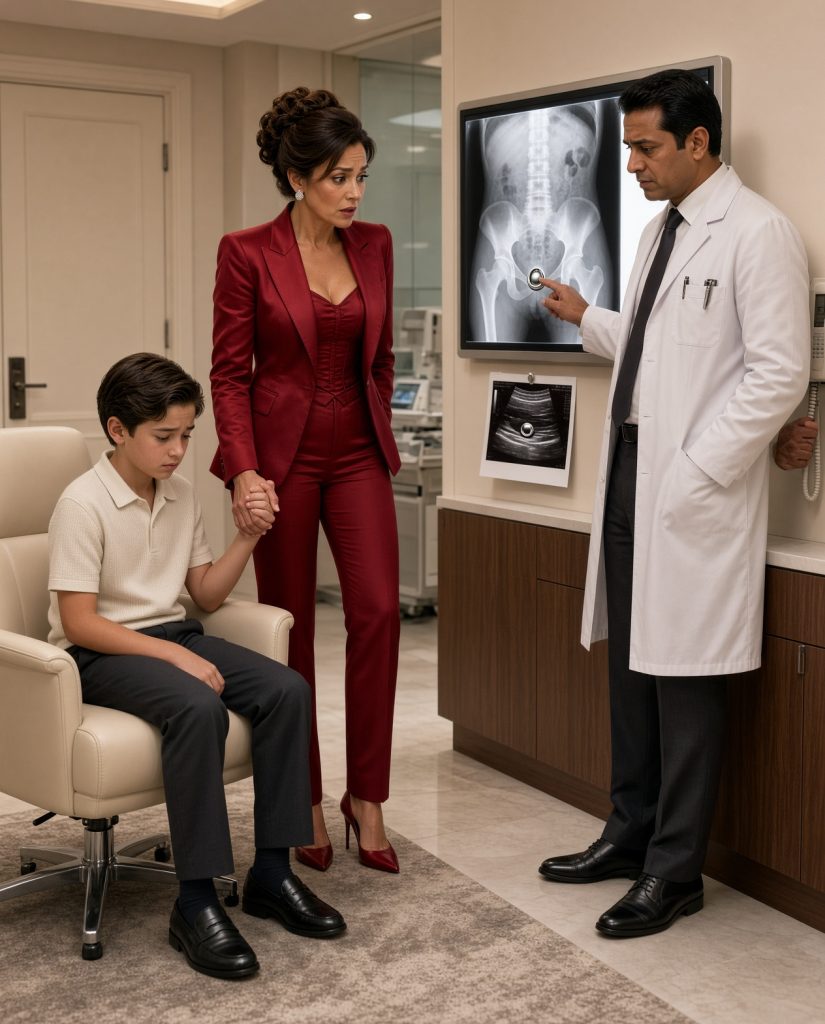
Twenty minutes later he brought us into a consultation room. A nurse closed the door behind us.
Dr. Shah placed the ultrasound printout and X-ray on the lighted panel. The X-ray showed a small, dense oval object low in Theo's abdomen.
"This appears to be metal," he said. "It is not where it should be, and the tissue around it looks irritated."
My first thought was absurdly ordinary. A coin. A toy part. Something Theo had swallowed by accident and been too embarrassed to mention.
"Can it pass?"
"It should have passed already," Dr. Shah said. "Given the inflammation and how long he's had symptoms, I don't want to wait."
He looked at Theo, then at me.
"Mrs. Armitage, before anyone calls your husband, I need to ask who has been alone with Theo since this pain began."
The question made the room feel smaller.
"His father. Our staff. Me. Why?"
Dr. Shah did not answer immediately. Instead, he pointed to the enlarged image. The object was too symmetrical to look accidental: a smooth capsule, narrower than my little finger, with a faint seam around the middle.
Theo's hand went rigid inside mine.
I felt it before I understood it.
Fear.
Not fear of surgery. Fear of recognition.
Dr. Shah noticed too. He lowered himself until he was closer to Theo's eye level.
"Theo," he said gently, "did someone tell you to swallow this?"
Theo nodded.
"Who?"
He stared at the floor. His lips parted.
His answer came out so softly I nearly missed it. "Dad gave it to me."
Dr. Shah did not look surprised. He looked careful. He asked Theo what "gave" meant, and my son pressed both hands between his knees before whispering that, three weeks earlier, he had walked into Adrian's study during a thunderstorm. Adrian had a tiny silver capsule on the desk beside stacks of foundation papers. When Theo asked what it was, Adrian told him it was a vitamin and ordered him to swallow it with water. Theo said no. Adrian locked the study door, gripped his face, and told him the police would take me away if he ever talked about what happened.
My mind tried to reject the words, but Theo kept going. Adrian had checked the bathroom trash every morning afterward. Twice, he had asked whether Theo had "seen the silver thing" after using the toilet. When the stomach pain began, Adrian told him that doctors would cut him open if he complained.
Dr. Shah reached for the wall phone. "I'm calling the children's hospital and our safeguarding team," he said. "Please do not contact your husband yet."
The scan showed the capsule lodged low in Theo's intestine, with swelling around it. It had not passed. He needed urgent removal.
As the nurse prepared the transfer, Theo caught my sleeve. "Mom, I didn't know it was bad."
I knelt in front of him and told him the only thing that mattered was that he had finally told me.
Then Dr. Shah placed the printed scan in an evidence envelope instead of handing it back to me.
"Mrs. Armitage," he said, "if that capsule contains what I suspect, this may be bigger than a medical emergency."
At the children's hospital, the medical team moved faster than my thoughts could. A surgeon explained that the capsule was lodged near the end of the small intestine and had begun causing a localized injury. They hoped to retrieve it endoscopically, but they prepared me for the possibility of surgery if it could not be reached safely.
A hospital social worker sat with Theo while another clinician photographed a faint bruise along his jawline that I had assumed came from soccer. No one accused him of lying. No one asked why he had waited. They asked what would help him feel safe.
He said, "Don't let Dad come in."
That sentence broke whatever denial I still had left.
I signed the consent forms.
Before they took Theo upstairs, a police detective and a child-protection investigator arrived. The detective did not ask Theo for a full statement. She said the priority was medical care and that a trained interviewer could speak with him later, once he was stable. She asked me instead about Adrian's recent behavior, the foundation, the study, and why he had resisted medical treatment.
For the first time, details that had seemed unrelated snapped into a pattern.
Adrian had dismissed our longtime controller six months earlier. He had insisted on personally approving several new vendors. He had pushed the board to authorize a rushed expansion fund for pediatric clinics in rural counties, then became furious when two trustees requested a forensic audit before releasing the second round of money.
That morning's breakfast with the auditors had not been ceremonial. It had been a confrontation.
My phone began vibrating inside my purse.
ADRIAN.
Then again.
Then twelve times in twenty minutes.
A message appeared: Where are you?
Another: Theo isn't at school.
Then: Call me now.
The detective asked me not to respond yet.
The procedure took just under two hours. The surgeons managed to remove the capsule without opening Theo's abdomen. When the doctor came out, he said the bowel looked irritated but viable. Theo would need monitoring, medication, and follow-up, but there was no perforation.
I cried so hard I had to sit down.
The capsule itself went directly into a sealed evidence container. I did not touch it. I did not see it opened. The detective told me they would seek the proper legal authority before examining anything inside.
That mattered later, because Adrian's attorneys would challenge nearly every step.
At 4:17 that afternoon, Adrian arrived at the hospital with our family attorney and the polished composure he used at board meetings. He demanded to see Theo. Security stopped him outside the pediatric floor.
He saw me through the glass doors.