By the time the string quartet began its second pass through the processional music, I had already learned the truth about my marriage.
I was twenty-four, dressed in ivory, and standing outside the glass conservatory chapel on the Drago estate north of Chicago. Beyond the doors, two hundred guests waited beneath white roses and suspended candles. Half of them represented old money. The other half represented the kind of power that never appeared on a balance sheet. My father, Rocco Vale, had spent six months calling the wedding a union of families. Everyone else understood the less delicate version: the Vale shipping interests controlled the South Harbor terminals, and Lucian Drago controlled nearly everything that moved through the north side of the city's private freight network.
The marriage was supposed to end a dangerous business standoff before a rival family could exploit it.
It was also supposed to end the life I had planned for myself.
Before the engagement, I had been preparing to leave for Florence to study art conservation. My mother, Elena, had encouraged it before she died. She used to say that restoring a damaged painting was an act of faith because you had to believe there was still something worth saving beneath the grime. My father called the degree indulgent. When Lucian's proposal arrived through attorneys instead of flowers, Rocco treated my future like a line item he had finally learned how to monetize.
I did not expect romance from Lucian. He was thirty-nine, controlled, intimidating, and famous in our world for making decisions without repeating himself. During our engagement he had been impeccably polite and almost aggressively distant. He never touched me without permission. He never pretended affection. I had decided that if love was impossible, respect might still be negotiable.
Then, five minutes before the ceremony, I heard him speaking in the library.
I had taken the wrong corridor while looking for the woman carrying my mother's antique handkerchief. The library door stood partly open. My father's voice came first, low and pleased.
"Once the license is filed, the harbor problem disappears."
Lucian answered, "The alliance solves the problem."
One of his attorneys asked whether the living arrangements had been settled.
Lucian's reply was flat enough to stop me in the hallway.
"I do not need a bride. I need her harbor. Give her the west suite, a driver, whatever she wants. I will keep my side of the bargain."
My father laughed.
That sound hurt more than Lucian's words. Lucian barely knew me. My father did.
I looked down at my bouquet and understood that every soft detail around me had been designed to disguise a transaction. The roses, the pearls, the orchestra, the silk ribbon around the stems – all of it wrapped around the same ugly fact. I was an access point to property.
For one reckless second I considered walking out the service entrance and disappearing.
Then I saw Adrian Bell.
He had been my mother's personal attorney for nearly twenty years, and he was standing alone near the last row of chapel seats with a navy legal folder tucked under his arm. I had not invited him. My father disliked him and had made that dislike clear after my mother's death. Yet Adrian met my eyes through the open chapel doors and gave me a small, steady nod.
The sight of that folder changed something in me. My mother had left sealed documents with Adrian, with instructions that I would receive them when I was married or turned thirty, whichever came first. I had asked about them once. Adrian had only said that Elena wanted me to have choices when other people became most certain that I did not.
I still did not know what was inside.
But I stopped thinking about escape.
If men were going to turn my wedding into a negotiation, I could at least arrive at the table awake.
My father came to collect me. He told me I looked pale. I told him I was warm. He offered his arm with the self-satisfaction of a man delivering a successful acquisition, and I took it because the doors were opening and because leaving in fear would have felt too much like letting him write the ending.
Lucian waited at the altar in a dark tuxedo, expression unreadable. When I reached him, his gaze moved over my face once and sharpened.
"Are you all right?" he murmured.
"I will be."
It was the first honest sentence either of us had spoken that day.
The ceremony began. We repeated vows that sounded dangerously intimate for two people whose attorneys had negotiated most of their future. When Lucian promised to honor me, I almost laughed. Instead, I held his gaze long enough that he knew I was testing the word.
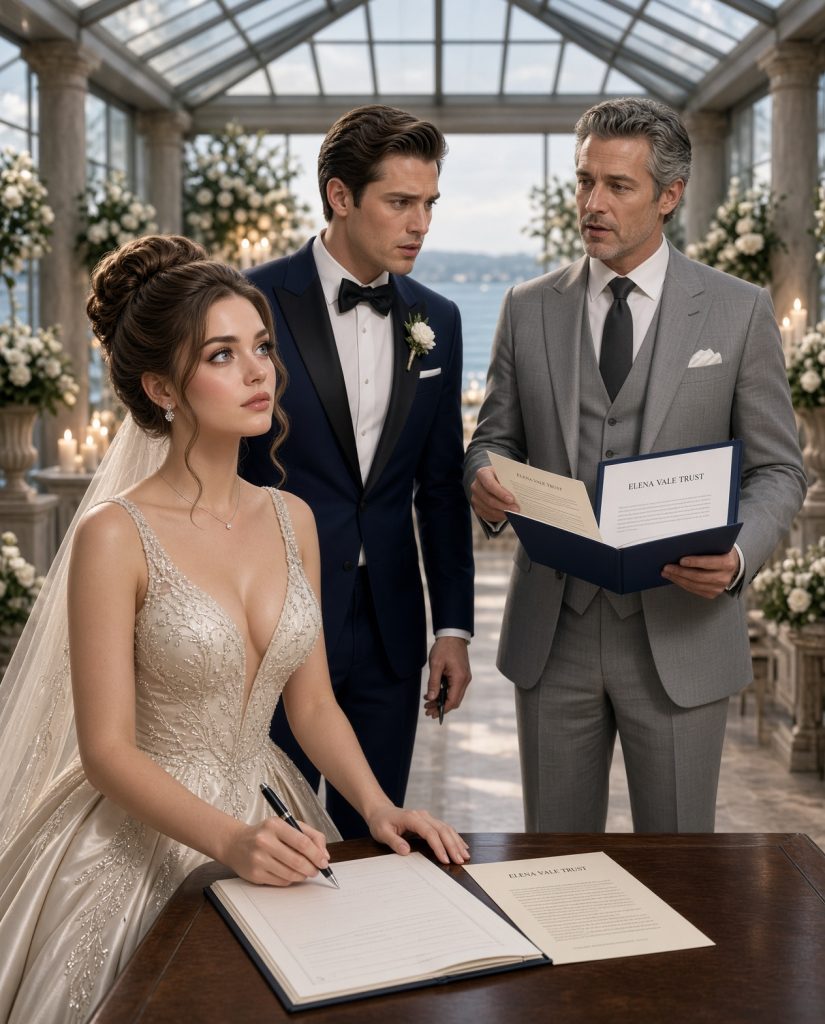
At the civil signing table, before either of us touched the register, I spoke quietly enough that only Lucian, Adrian, and the officiant could hear.
"I want three things understood before I sign. No locked doors. No orders about my education. No child demanded on anyone else's timetable."
My father made an angry sound behind me.
Lucian did not look at him.
"Agreed," he said.
"In writing."
A flicker of surprise crossed his face, followed by something that looked almost like approval.
He gestured to his attorney. "In writing. Today."
That was the first smaller victory of my marriage: I had asked whether his promise of respect meant anything when I used my own voice, and he had answered in front of witnesses.
Then the officiant opened the civil register.
My father pushed the pen toward Lucian and told him to finish it.
Adrian stepped out of the last row with the navy folder already open.
He laid one cream-colored trust page beside the marriage license.
The heading bore my mother's name.
"Under Elena Vale's trust, the South Harbor shares transfer to Serafina alone at midnight – not to her husband."
The chapel went so quiet I could hear the fountain outside. Lucian took the pen and signed. He did not look at my father; he looked at me, as if the woman beside him had finally replaced the map he had been studying. "The deal changed," he said. "My word did not."
My father surged toward the table, furious that Mother's trust had escaped him, but Lucian stepped between us. He did not touch Rocco. He only said, "She is not collateral after the vows." Then he turned back to me and asked what I wanted written beside the marriage contract before the witnesses left.
I gave him three terms: my shares remained mine, my graduate program in Florence remained mine to accept, and no child would ever be demanded from me as payment for an alliance. Lucian called Adrian over and had every condition added to a witnessed marital agreement. He signed that too.
Hours later, after the orchestra had gone and the estate finally stopped pretending our wedding had been romantic, Lucian found me alone in the library. He placed a brass key on the table. It opened the west suite, the study beside it, and every exterior door I might need. "If you want an annulment, I will not fight you," he said. "If you stay, you stay because you choose it."
I had expected possession. Instead, the most feared man in the room had just surrendered the one weapon my father had always used against me: the belief that I had nowhere else to go.
I closed my fingers around the key. "I am staying tonight," I told him. "Tomorrow, you can show me who you are when there is nothing left to gain."
The next morning, my father arrived before breakfast.
He did not congratulate us. He demanded that I sign a voting proxy granting him control of the shares before midnight records closed. He called my mother's trust a sentimental mistake and accused Adrian of manipulating a dead woman's instructions. When I refused, he shifted tactics and reminded Lucian that Vale-controlled operating agreements could be canceled with thirty days' notice.
Lucian had spent half a year arranging his business around those agreements. Losing them would mean rerouting freight, paying penalties, and idling crews while lawyers fought. Everyone in the room knew the number would be painful.
My father knew it too.
"You wanted the harbor," Rocco said. "Tell your wife to sign."
Lucian set down his coffee.
"No."
There was no speech, no performance, no attempt to make the refusal romantic. He simply would not use our marriage to force my signature.
My father stared at him as if he had misunderstood the language.
"You are willing to lose millions over her mood?"
"It is not her mood. It is her property."
Rocco left with the contracts still in his briefcase.
By noon, Lucian's advisers were in the study calculating losses. I expected one of them to come upstairs and persuade me to reconsider. None did. Later I learned that Lucian had given a single instruction: no one was to discuss my shares with me unless I requested the meeting.